A PoC radio talks over a carrier’s data network, like a phone. That means the SIM decides where it works. If you are new to PoC, start with What is a PoC radio?.
Which kind of SIM
| Type | What it is | Watch out for |
|---|---|---|
| Regular phone SIM | Prepaid or postpaid line from any carrier | Easy to buy; each line is managed on its own |
| IoT/M2M SIM | Data line sold to businesses for devices | Ask whether the plan allows voice traffic from apps |
| Multi-network SIM | SIM from an IoT provider that can fall back to another network | Which networks it uses in your area, and how switching works |
Multi-network SIMs exist in the US market. Hologram, for example, sells IoT SIMs that use a native carrier profile first and roaming profiles as a fallback. Some PoC vendors also bundle a carrier SIM into their monthly fee; PoC radio cost shows published examples.
Whatever the type, the SIM needs data service turned on. Inrico lists a SIM not authorized for data and a used-up allowance among the reasons a radio fails to connect.
Do you need a voice plan?
No. On PoC, voice travels as data to the platform’s server, which relays it to the group. The radio does not use calling minutes or SMS to talk to the team.
How much data it uses
- Zello reports an average of 70 to 100 MB a month per user, 12 to 45 kbps while talking, and about 20 kB an hour when idle.
- Inrico reports 1 to 2 MB per hour of talk, and says higher audio quality, camera and video features and a poor network (which forces retransmissions) raise usage.
A small plan is usually enough. PoC radio cost adds up the device and platform too.
LTE bands: the device must match the carrier
A radio can only use a carrier’s 4G if it has that carrier’s LTE bands. Commonly listed bands in the US:
| Carrier | LTE bands |
|---|---|
| AT&T | 2, 4, 5, 12, 14, 17, 29, 30, 66 |
| Verizon | 2, 4, 5, 13, 66 |
| T-Mobile | 2, 4, 12, 66, 71 |
Compare the full list on the device page with the carrier’s, not just one or two bands. Band support alone may not be enough: Verizon requires a device to be unlocked and compatible with its network, checked by IMEI in its compatibility tool.
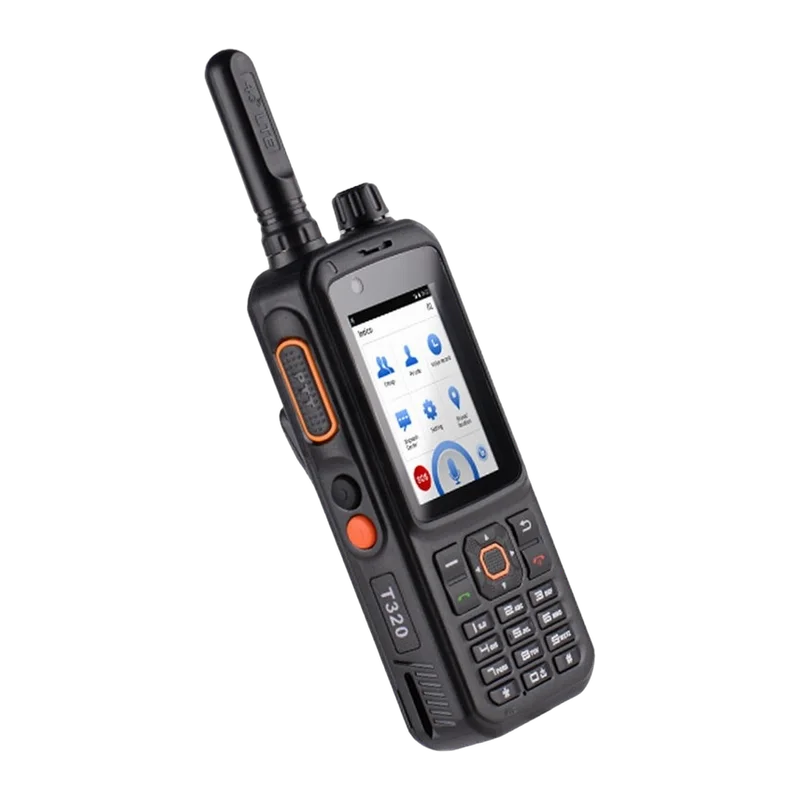
The same model can ship in versions with different bands. The Inrico T320 page, for example, notes that its listed bands are the EU version and that the US and Asia versions differ. Ask for the US version and check the devices with FCC approval.
FirstNet, the public-safety network built with AT&T, is deployed under the FirstNet Authority on Band 14, spectrum set aside for public safety. It is built for first responders.
Coverage where your team works
- The FCC National Broadband Map. Search an address and switch to the Mobile Broadband tab to compare the 3G, 4G and 5G coverage each carrier reports. The FCC notes that these maps come from carrier propagation models, reflect outdoor or in-vehicle use, and that carriers’ own maps may use different assumptions.
- Carrier maps. Useful, but they are predictions too.
- A field test. Before buying for the whole team, test a SIM from each carrier where the team works, indoors included.
Many smaller brands, such as Cricket and Straight Talk, run on the AT&T, Verizon or T-Mobile networks, so their coverage follows the host network.
3G is gone
US carriers have already shut down 3G. According to the FCC, AT&T began phasing out 3G in February 2022, T-Mobile shut Sprint’s 3G CDMA network by March 31, 2022 and its own 3G UMTS network by July 1, 2022, and Verizon set December 31, 2022 to finish its 3G shutdown. A 3G radio no longer has a network to use at these carriers; buy LTE.
Dual SIM and failover
Two SIMs from different carriers raise the odds of finding signal. Each device page on PTToC says whether it takes two SIMs. Ask the manufacturer whether the device switches the data SIM by itself when one loses signal, or whether switching is manual.
eSIM
An eSIM is an embedded SIM that the carrier downloads to the device. In the PTToC catalog few handheld radios list eSIM; it is more common on rugged phones. If a radio has no screen or camera, ask how the eSIM is activated.
Wi‑Fi and APN
Where Wi‑Fi is available, a PoC radio can use it instead of the SIM. Inrico suggests turning Wi‑Fi off when its signal is weak so the radio falls back to mobile data.
The APN is the name of the carrier’s internet access point, and the carrier gives you the right value. Inrico lists a wrong APN among the reasons a radio fails to log in. On radios without a screen, both the APN and the Wi‑Fi password are written with the manufacturer’s programming software.
Before you buy
- Does the device have your carrier’s LTE bands, and FCC approval?
- Does the SIM have data enabled? Voice is not needed.
- Does the carrier have signal where the team works, including indoors?
- Do you need two SIMs or eSIM, and who sets the APN?
To browse models, start with handheld PoC radios, use the comparison or answer five questions in Help me choose.
See also: How to choose a PoC radio and Do PoC radios need a license?.



 *